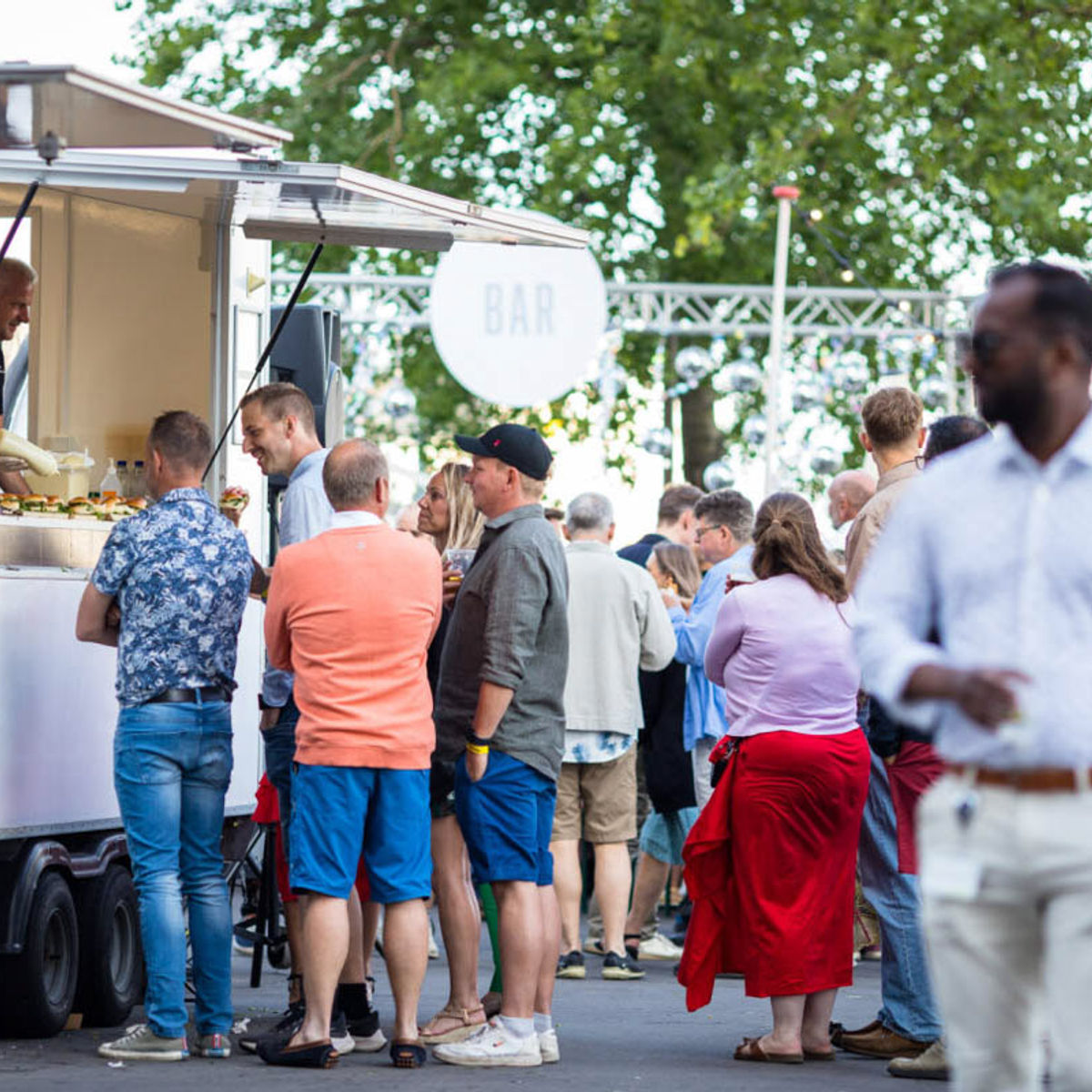
On Nuento, customers typically pay around £930 for a food truck for 50 guests (the median for all types), staff and set-up included, travel extra. The price varies with the type of food and the price level.
How to price your food truck: set prices that actually make a profit

Plenty of food trucks that struggle financially don't serve bad food. They have simply set their prices by what the burger van down the road charges, or what a competitor puts on their website. The trouble is that neither of them has your costs.
A good price starts with your own numbers. This guide shows you how to work out your costs, build a price that holds up at both 30 and 300 guests, and factor in pitch fees, a share of takings and VAT before you say yes. At the end you can see what customers typically pay for a food truck on Nuento, so you have something to hold your own price up against.
Always check the current rules
VAT and tax rules change. This article does not replace the official sources or your accountant. Always check the current rules with the authorities before you make decisions:
- GOV.UK – Register for VAT
- GOV.UK – Catering, takeaway food (VAT Notice 709/1)
- Food Standards Agency – Register a food business
Last checked: 5 November 2026
Start with your costs – not your competitors' prices
Before you can set a price, you need to know what an event costs you. It's easiest to split your costs into three buckets:
1. Costs that follow the number of guests
Ingredients
Packaging, cutlery and napkins
Drinks, if they're included in the price
2. Costs that follow each event
Wages – including time spent shopping, prepping, driving, setting up and clearing down, not just the hours you're serving
Fuel for the van or tow vehicle
Gas, electricity or generator hire
Pitch fees or a share of takings
Commission or service fees to platforms
Extra equipment you hire for that particular event
3. Costs you pay whether you trade or not
The vehicle: finance repayments or what it loses in value
Insurance
Servicing, MOT, and gas and electrical safety checks
Storage over the winter
Accounting software, an accountant, phone, card reader
Marketing, website, photos
The first two buckets have to be covered by every single event. The third has to be covered by the year as a whole. If you're new, you rarely know how many events you'll get in your first year. So turn the sum around: add up your fixed costs for a year and work out how many events you need to cover them. That's your break-even point.
Remember your own wage too. If you leave out your hours because "it's just me", the numbers look better than they are – and you only find out when you have to hire someone to take your place.
Base price plus price per head
For private parties and corporate events, many food trucks work with a fixed base price plus a price per head. It's a good model because it follows your costs:
The base price covers everything that costs the same whether 40 or 120 guests turn up: travel, setting up, clearing down, the core staff hours, gas and a share of your fixed costs.
The price per head covers what grows with the number of guests: ingredients, packaging and the extra pair of hands you need for big groups.
Picture a food truck with a base price of £300 and £12 per head (both figures are made-up examples):
| Guests | Base price | Per head | Total price | Price per guest |
|---|---|---|---|---|
| 30 | £300 | £360 | £660 | £22.00 |
| 50 | £300 | £600 | £900 | £18.00 |
| 100 | £300 | £1,200 | £1,500 | £15.00 |
The price per guest falls as the number of guests goes up, because the base price is shared out over more people. That's completely normal, and you'll see the same pattern in customers' prices on Nuento further down. The customer gets a better price per guest for a big party, and you still cover your fixed costs on the small ones.
Think of your price list as an average across all your bookings, not a sum that has to come out exactly every time:
At small events, the base price can leave you a little extra profit. You can handle them with the staff the base price is worked out for, say one or two people.
At large events, the base price can cover slightly too little. It's mainly the staff that make the difference: you need more hands in the truck to cook and serve food for every guest within the same serving time, and the extra wages aren't in the base price. If the customer wants a longer serving time, that's a different matter – most food trucks charge extra for it.
Ingredients, on the other hand, can get cheaper per guest at large events, because you buy in bigger quantities.
What matters is that it adds up over a season. If big parties become too expensive for you, you can build a step into your price, for example an extra member of staff from a certain number of covers.
Set a minimum spend
A minimum spend protects you from the bookings where you spend a whole day on 15 people. Travel, setting up and clearing down take roughly the same time however many people eat.
Work out your minimum spend backwards: what does a day need to bring in at the very least, once you've paid for ingredients, wages, fuel and gas and added your contribution to fixed costs?
With a minimum spend, a small event for 15 guests suddenly becomes worth taking. The customer can reach the minimum spend by choosing a bigger menu, such as all you can eat, or by paying a higher price per head. That way you can say yes to small parties without losing money on them.
Some food trucks raise their minimum spend in peak season, when the diary is full, and lower it outside the season. It's a sensible way to manage demand.
Test your price list on a typical booking
Once you've set your price, that's what customers see and book from. On Nuento you have one price list: a base price, a price per head and any extras, and it's the same for every booking. So the work happens once, when you set your price – not every time a customer gets in touch. In return, the price has to hold up on the bookings you typically get.
That's why it's a good idea to test your price list on a typical booking before you publish it. Picture a corporate party for 80 guests that you've booked directly, at a total price of £1,260 including VAT (all figures are made-up examples):
| Item | Amount |
|---|---|
| Customer's price incl. VAT | £1,260 |
| – VAT (one sixth of the price incl. 20% VAT) | –£210 |
| Your income excl. VAT | £1,050 |
| – ingredients and packaging (80 × £4) | –£320 |
| – wages (2 people × 9 hours × £16) | –£288 |
| – fuel and gas | –£60 |
| Left for fixed costs and profit | £382 |
That £382 isn't profit yet. It first has to help pay for insurance, the vehicle, servicing and everything else in the third bucket. If, say, your fixed costs come to £4,700 a year, you need around 12 events like this one to break even (£4,700 ÷ £382). Event number 13 is the first one you make money on. If that sounds like a lot of events for your first season, it's a sign the price needs to be higher. Check your hours too: in the example, wages are worked out at 9 hours per person. If you really spend 11 hours once driving, setting up and clearing down are counted, there's less left over.
Do the same for a small and a large booking, for example 30 and 150 guests. If the price holds on all three, your price list is ready. Then look at it again after the season: did your hours and ingredients match reality? If not, adjust the price list once so it fits from then on.
If the booking comes through a platform, there also has to be room for the platform's fee. On Nuento, the service fee is 15% on bookings that come through Nuento. So don't let your margin get too thin – there's more about Nuento further down.
Markets and festivals: work out each event on its own
Markets, festivals and street food events are the one place where you need to work out each event on its own. Here you usually sell dishes straight to the public and pay the organiser for your pitch – as a fixed pitch fee, as a percentage of your takings, or both. Some also charge for a power hook-up. And the risk is yours: if it rains, fewer people come, and the pitch fee still has to be paid.
Picture a market day with a £200 pitch fee, 15% of takings to the organiser and £50 for power. You sell dishes at £10 including VAT. Ingredients cost £3 per dish, and three of you work 12 hours at £16 an hour (all figures are made-up examples):
| Item | 200 dishes sold | 300 dishes sold |
|---|---|---|
| Takings incl. VAT | £2,000 | £3,000 |
| – VAT | –£333 | –£500 |
| – share of takings (15%) | –£300 | –£450 |
| – pitch fee | –£200 | –£200 |
| – power | –£50 | –£50 |
| – ingredients | –£600 | –£900 |
| – wages | –£576 | –£576 |
| Result before fixed costs | –£59 | +£324 |
Same market, same price, same van. In this example you need to sell around 216 dishes just to break even – and whether you sell 200 or 300 can come down to the weather.
So before you apply for a pitch, always ask yourself:
How many dishes do I need to sell to break even? And how many can I realistically serve per hour?
How many visitors are expected, and how many other food traders will be there?
What happens if it rains?
If the pitch fee and the share of takings are bigger than the margin you can realistically expect, say no. It's better to take the day off than to pay to work.
Commission and a share of takings: build them in from the start
Festivals, some markets and booking platforms take a slice of your sales instead of – or on top of – a fixed pitch fee. That's often a fair model, because you only pay when you sell. But the percentage needs to be in your sums from the start, not deducted afterwards.
Three things to watch:
Work from the amount you actually receive. Your price needs a margin that can carry the fee. On many platforms, Nuento included, the price has to be the same as you charge elsewhere, so you can't simply add the fee on top.
Find out what the percentage is calculated on. Is it the amount including or excluding VAT? Are drinks and extras included? It's in the terms, and it makes a difference.
Read the terms every year. Festivals often change their terms from one year to the next, and some charge a pitch fee plus a percentage once you pass a certain level of takings. Always read the current version before you apply.
On Nuento it's free to join – no subscription and no fixed fees. You only pay a service fee on the bookings you choose to accept:
15% on bookings that come through Nuento. These are customers Nuento has found for you. The price you set on your profile is the total price the customer sees, and you receive that amount minus the service fee. So include it when you set your base price and price per head.
2% on customers you send to Nuento yourself, for example through a booking button or a link on your own website. That gives you Nuento's booking system, payment handling and invoicing at a low cost, even for customers you found yourself.
Your price on Nuento has to be the same as the price you advertise elsewhere. But you can set a higher minimum spend on Nuento than usual if it makes sense for you, so small bookings still pay once the service fee is taken.
Remember VAT
You must register for VAT if your VAT-taxable turnover over the last 12 months goes over £90,000, or if you expect it to go over £90,000 in the next 30 days. Below the threshold you can choose to register voluntarily. Check the current rules on GOV.UK.
If you're VAT-registered, one sixth of the price a customer pays including 20% VAT isn't your money. Of £1,200 including VAT, £200 is VAT that you pass on to HMRC. It sounds obvious, but working out your margin on the VAT-inclusive price is a classic mistake. Hot takeaway food and catering are standard-rated, while some cold takeaway food can be zero-rated – see VAT Notice 709/1 or ask your accountant.
If you're not VAT-registered, you keep the full price, but you can't reclaim VAT on what you buy. Keep an eye on your turnover as it grows, so passing the threshold doesn't take you by surprise.
When you compare yourself with other people's prices, make sure you're comparing like with like.
What customers pay for a food truck on Nuento
The figures below are the total price the customer pays for the event, staff and set-up included, travel extra. As a supplier, you receive that amount minus the service fee (15% on bookings that come through Nuento).
"Low", "median" and "high" show suppliers' price levels: low is a low price level, median is the typical one, and high is a high price level. Use them as a benchmark – not as the answer. Your price still needs to rest on your own numbers.
50 guests
| Type | Low | Median | High | Median per guest |
|---|---|---|---|---|
| Food truck (all types) | £600 | £930 | £1,060 | £18.60 |
| Street food (all types) | £620 | £900 | £1,000 | £18.00 |
| Pizza | £600 | £780 | £910 | £15.60 |
100 guests
| Type | Low | Median | High | Median per guest |
|---|---|---|---|---|
| Food truck (all types) | £1,010 | £1,610 | £1,850 | £16.10 |
| Street food (all types) | £1,090 | £1,540 | £1,750 | £15.40 |
| Pizza | £1,140 | £1,400 | £1,600 | £14.00 |
Prices from suppliers on Nuento across the UK. Rounded to the nearest £10 and 10p per guest. Retrieved 5 November 2026.
Two things to notice:
The price per guest falls as the number of guests goes up in every category – exactly as in the base price and price per head example. For food trucks overall, the median goes from about £18.60 per guest at 50 guests to about £16.10 at 100 guests.
The range is wide. Within the same type of food there can be several hundred pounds between a low and a high price level. That comes down to ingredients, the size of the menu, how many staff are included and how much in demand the truck is. If you're at the top end, your profile needs to show why: good photos of the truck and the food, a clear menu and good reviews.
If you'd like to see how other food trucks present themselves and their prices, have a look around Nuento's food truck page.
Seasons and a buffer
The UK street food season is short. Many food trucks earn most of the year's money between spring and late summer, while fixed costs run all year. Your pricing has to allow for that:
Know how many events you need to break even. If you keep an eye on it during the season, you can see whether you're on track or whether the price needs adjusting.
Build a buffer. Put a fixed part of every booking aside for the quiet months, garage bills and the event that gets cancelled. Many food truck owners say the first year is the hardest – partly because takings swing with the season and the weather.
Plan for winter. Christmas parties, corporate events and indoor events can keep money coming in outside the season. They're often bookings with a known number of guests and a fixed price, so less risky than a market.
Review your prices regularly. If ingredients or fuel go up, run your numbers again. Better a small adjustment every year than a big one when the margin has already gone.
Remember the money often comes afterwards. With many bookings you're paid after the event, while you've already paid for ingredients and wages. Make sure you have the cash flow for it.
In short
Work out your costs in three buckets: per guest, per event and fixed.
Build your price as a base price plus a price per head, and set a minimum spend.
Test your price list on a typical, a small and a large booking – with fees and VAT – and adjust it after the season.
Work out each market and festival on its own, and say no when the pitch fee is bigger than the margin you can realistically expect.
Compare yourself with the market, but let your own numbers decide the price.
Build a buffer for winter and the bad days.
More from the guide
Frequently asked questions
 By Mathilde Neuvecelle· 5 Nov 2026